


5 mistakes when welding bitumen – and how to avoid them
Whether on a flat roof, for waterproofing, or during repair work: when welding bitumen, clean workmanship determines whether it stays watertight or leaks. Many mistakes happen not out of ignorance, but due to time pressure or incorrect tools. These exact mistakes will cost you money, time, and, in the worst case, your client.
In this article, we show you the most common mistakes made when welding bitumen – and how to avoid them properly. With the right technique and the appropriate roofing tools , you work more efficiently, safely, and much more professionally.
1. Incorrect temperature during welding
The classic: the membrane is not heated properly or it is completely overheated. Too little heat means the bitumen membrane will not bond cleanly with the substrate. Too much heat destroys the structure; the bitumen burns or becomes brittle.
Many work by "feel" here – that might work in the short term, but it is not consistently clean.
Solution:
Pay attention to a uniform flame pattern and clean guidance.
The bitumen should shine slightly and become soft – not smoke or form bubbles.
With a reliable
torch
you have control over the heat and achieve reproducible results on the construction site.
2. Substrate not prepared
Dust, moisture, old residues, or loose parts on the substrate ensure that the bitumen membrane will not adhere. The result: the waterproofing looks good at first – but quickly starts to leak.
This mistake often happens because people want to "save time." In reality, that is exactly what will cost you twice as much time later on.
Solution:
The substrate must always be dry, clean, and load-bearing.
When in doubt, clean, sweep, or prime it.
Without a clean base, even the best tools are of no use to you.
3. Insufficient contact pressure
Even if the temperature and substrate are correct, the contact pressure is often underestimated. The membrane is heated, but not pressed down properly – this leads to the formation of voids.
These hollow spots are the places where water will later collect and the waterproofing will fail.
Solution:
Work evenly and with pressure immediately after heating.
With a
seam roller
, you can press the membrane down cleanly and create a full-surface bond.
This ensures durability and prevents later damage.
4. Incorrectly welded overlaps
The seam is the most critical part of any waterproofing. This is where it is decided whether the roof remains watertight or not. Many work too quickly or too inaccurately here.
Too little heat, uneven guidance, or a lack of pressure result in water penetrating exactly at these points.
Solution:
Always heat overlaps evenly and weld them cleanly.
A slight bit of bitumen bead shows that the seam is tight.
Work particularly cleanly here – that is the difference between a pro and a beginner.
5. Wrong tools, untidy cuts, and missing capillary cuts
Untidy cuts are an underestimated problem. If the membrane is not cut precisely, poor transitions, open edges, and messy seams occur.
Even more critical are missing capillary cuts: Without these, water can be drawn under the membrane through capillary action – even if everything looks tight.
Especially with connections, corners, and overlaps, this small step determines long-term watertightness.
Solution:
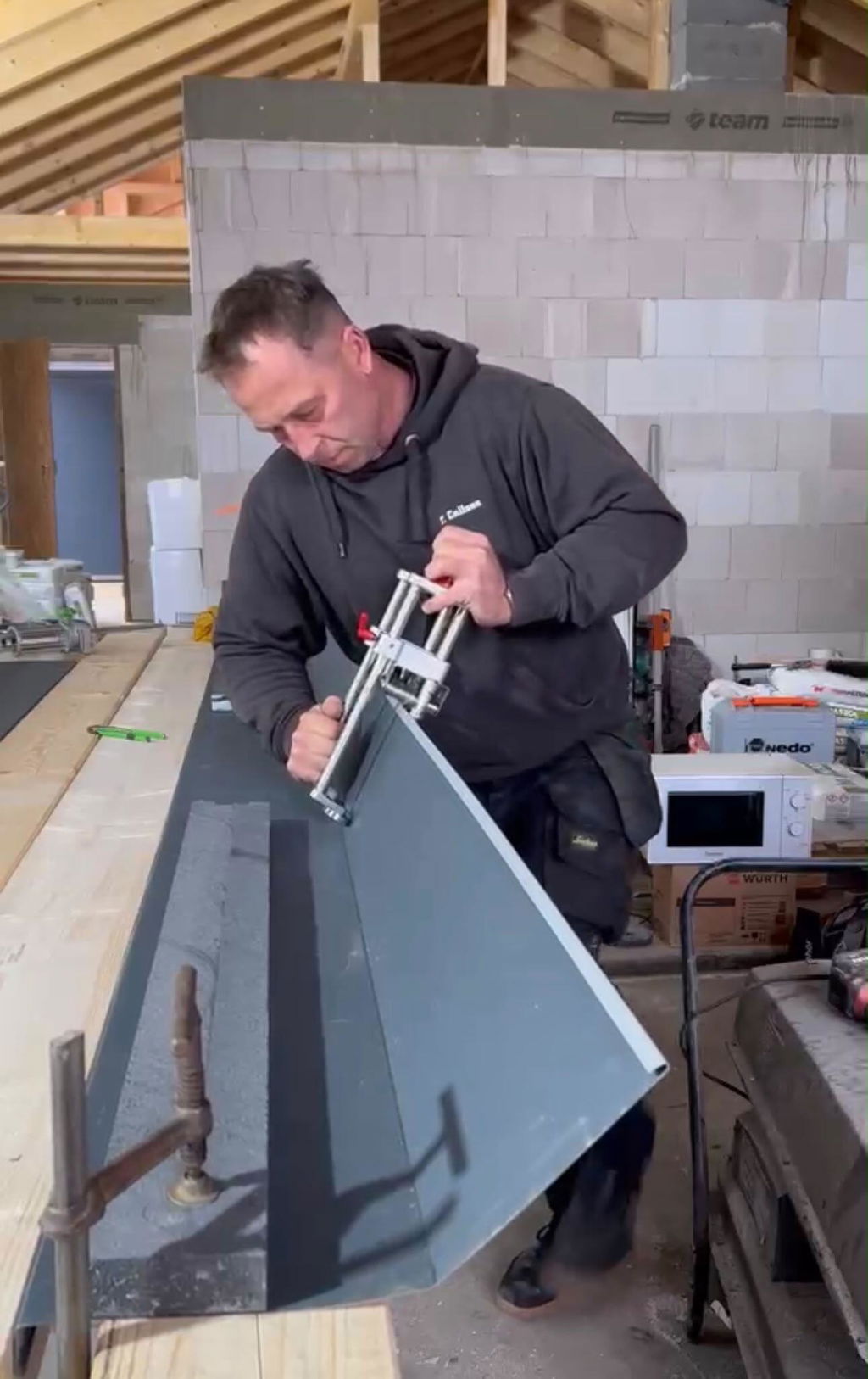
Rely on clean, precise cuts with the
Bitumen PRO
or a
utility knife.
In addition, you must make targeted capillary cuts to interrupt the water flow.
This prevents moisture from being drawn under the waterproofing and saves you from later damage.
Conclusion: Clean workmanship is the deciding factor
Welding bitumen is not just about experience, but about details. Every small mistake adds up – and in the end, you pay for it with time, money, or complaints.
If you work cleanly, use the right tools, and avoid typical mistakes, you will work faster, more efficiently, and on a completely different level.
With the right setup, such as a torch, seam roller, Bitumen PRO, and utility knife, you are on the safe side.
👉 Secure yours now in the roofing shop at Dach PRO and start working better immediately.